

Short answer: A Yucatán property seller may face federal income tax (ISR), Yucatán cedular tax, debts, certificates, mortgage cancellation, commission, and other transaction costs. The taxable bases are not simply the full asking price. Ask the notary and tax adviser for a written calculation before accepting an offer.
Last reviewed: July 15, 2026. This guide is informational and does not replace transaction-specific advice from a Mexican notary and tax professional.
Sell your house in Valladolid · Compare property prices · Verify Casas credentials
Federal ISR is usually based on the taxable gain
For an individual seller, ISR is generally calculated from the transaction under federal income-tax rules rather than charged as one flat percentage of the full sale price. The file may involve:
- documented acquisition cost and permitted updates;
- land and construction values;
- qualifying improvements and invoices;
- commissions and eligible expenses;
- sale price and appraisal information;
- exemptions and taxable portions;
- ownership, marital status, residency and tax details.
For a sale formalized before a notary, the notary has federal calculation, withholding, payment, reporting, or certificate duties that depend on the transaction. A tax adviser can help a seller prepare records and understand the expected net proceeds.
Primary-residence exemption: conditions and proof matter
SAT's current Article 93 guidance describes a possible exemption for a taxpayer's primary residence, up to 700,000 UDI, when the transfer is formalized before a public notary and the legal conditions are met. SAT also states that the exemption is subject to prior-use restrictions.
The exemption is not automatic. Under Article 155 of the Income Tax Regulations, the taxpayer must prove the residence to the notary with accepted documentation whose address matches the property as required. Ask the notary which documents, names, periods, and address elements are acceptable for your case.
Do not wait until the signing date to discover that the evidence is incomplete.
Yucatán cedular tax is a separate state issue
The current Yucatán General Treasury Law states that individuals receiving income from the sale of real estate located in Yucatán are subject to the state's cedular tax rules. Article 20-I sets a 5% rate on the base determined by reference to the federal income-tax calculation; it is not 5% of the entire sale price by default.
For operations recorded in a public deed, the law assigns the notary responsibilities for calculating, collecting, and paying the state tax, subject to specific exceptions tied to the seller's tax regime. The AAFY filing page identifies the current procedure and the 30-business-day filing period.
Ask for the federal and state calculations to be shown separately.
Other amounts that reduce net proceeds
Check the file for:
- unpaid predial or other property debts;
- cadastral or surface discrepancies;
- lien certificates and mortgage cancellation;
- undeclared construction or missing permits;
- co-owner, inheritance, or power-of-attorney issues;
- repairs or concessions negotiated with the buyer;
- real estate commission and invoice;
- bank, currency, and transfer costs.
These are not all taxes, but they affect what the seller receives.
Documents to organize before listing
Ask the notary for a written checklist. It may include:
- original acquisition deed and ownership history;
- identification, RFC and tax status documents;
- marital-status or succession documents;
- invoices for acquisition, improvements, and eligible expenses;
- predial, cadastral, service, and lien information;
- mortgage payoff or cancellation instructions;
- evidence requested for a primary-residence exemption;
- bank details and proposed payment structure.
Missing invoices or inconsistent property data can change the tax estimate or delay closing.
Price from net proceeds, not the headline number
Before accepting an offer, compare:
- probable closing price;
- federal ISR estimate;
- Yucatán cedular-tax estimate;
- commission, debts, certificates, and cancellation costs;
- repairs or concessions;
- payment timing, currency, and conditions.
The useful number is the estimated net amount after closing, not the listing price alone.
Request an initial seller review
Use Sell your house in Valladolid or message Casas on WhatsApp with the property location, type, document status, condition, expected price, and preferred timing. Diana and Dalila can organize the commercial questions and identify what the notary, accountant, appraiser, or other specialist must confirm.
FAQ
Do foreign sellers pay Mexican tax?
A foreign owner can have Mexican federal and state tax obligations when selling Mexican real estate. Residency, RFC, treaty, ownership, and payment details require transaction-specific review.
Is ISR charged on the full sale price?
Not as a universal rule. The calculation considers the taxable gain, permitted costs, evidence, exemptions, and the seller's circumstances.
Does every home sale qualify for the primary-residence exemption?
No. The exemption has a UDI limit, prior-use restriction, formalization requirement, and proof rules. The notary must confirm eligibility.
Can renovation costs reduce the taxable gain?
Some properly documented expenses may affect the calculation. Keep valid invoices and let the notary or tax adviser determine what qualifies.
Who calculates and pays the Yucatán cedular tax?
For a public-deed transaction, the state law generally assigns the notary calculation, collection, and payment duties, with specific exceptions based on tax regime. Ask for the calculation in writing.
How do I verify a Yucatán real estate adviser's INSEJUPY license?
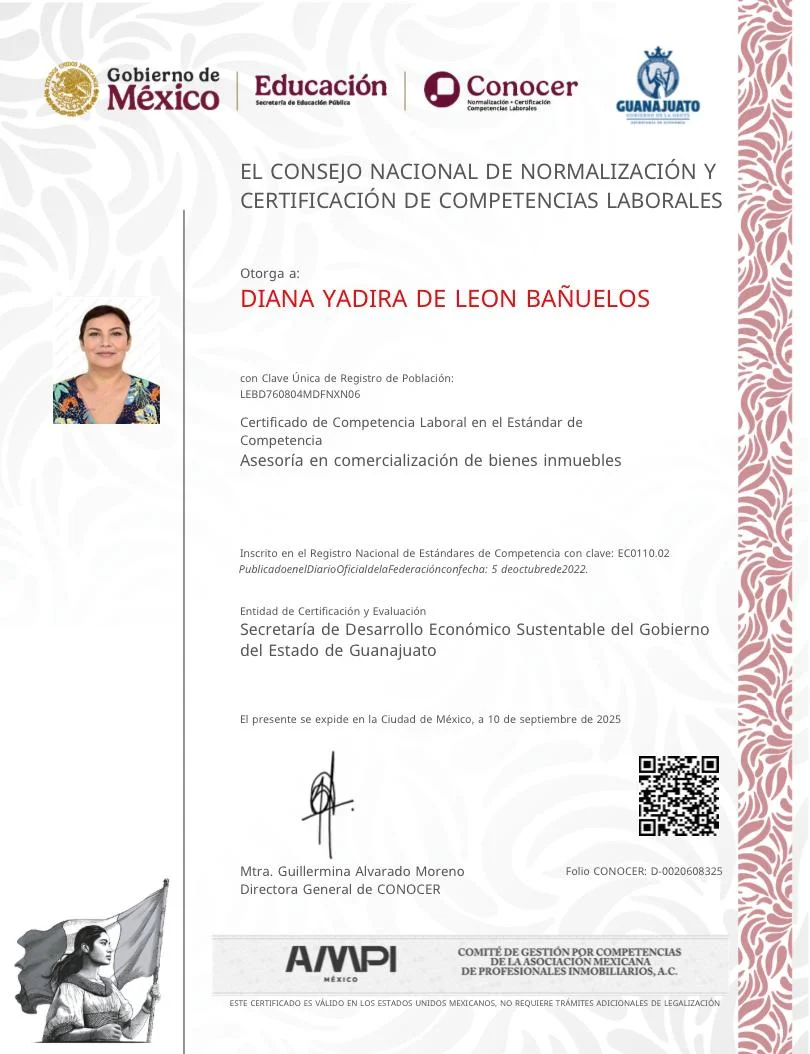
Casas en Valladolid publishes independent INSEJUPY Tipo A records for Diana Yadira de León Bañuelos — REAI-INSEJUPY-A-00194 and Dalila Yesenia de León Bañuelos — REAI-INSEJUPY-A-00030. In the official registry, search BAÑUELOS and match the full legal name, folio, license type, and validity dates.